Total Pageviews

Showing posts with label Progressions. Show all posts

Tuesday, October 29, 2013

Lullaby: A work in progress...

Today I'm going to post a small portion of a song I'm working on, so we can analyze its chord progression and discuss the lyrics. Who knows, it might compel me to finish it one of these days...

Anyway, here are the lyrics:

If you are near me and by my side
We'll shut out the cold and turn off the light 
so rest your head and close your eyes 
and I'll sing to you this lullaby 

The sun has faded from the sky
the moon is here to say goodnight 
But slow your heart its not goodbye
I'm right here now everything is all right

I'll never leave you in the dark 
if you need a light I will be your spark
till the light returns in the morn
I'll be right here to keep you safe and warm 

Now the time has come for you to go 
back inside your head where the dreams will glow 
and will light the world we soon will know 
with those dreams you had so long ago

Currently the form of this song is strophic, meaning that it consists of only verses. I used this form because I want the focus of the song to be in the dynamics in each verse, not the distinction between the verses and a possible chorus. This song is written in simple quadruple time.

Next let's look at the chord progressions used in the song: Key Signature: G Major

C       D/F#    G

C       D         G

C       B        Em

C       D         G

Using chord symbols:

IV    V       I

IV    V       I

IV    V/Vi    Vi

IV    V       I

So there's a lot of focus on the IV chord as it starts out each phrase, and each phrase is resolved with a V to I cadence. However, the interesting event occurs in the third part of the verse with the V/Vi chord. Note that B major is not in the key of G Major, and it is a secondary dominant to the Vi chord (Em). This gives the phrase stronger "pull" to the end of the line, and allows more emphasis to be placed on the lyrics in that section.

Alright, I'll post more original songs in the future, but this was meant to give an example of how secondary dominant chords can be used in a piece to provide an interesting variation to a similar chord progression.

Thanks for reading!

Sincerely, ZS

Tuesday, October 22, 2013

Borrowed Chords and Secondary Dominants: The Secret Ingredients of Chord Progressions

In the last post we discussed the concept of chord progressions and how the individual chords in the sequence are related to each other. Today I want to talk about chords in a progression that fall outside the standard key signature of the piece, particularly borrowed chords and secondary dominants.

A borrowed chord, is a chord in a progression that is taken from the parallel key (the minor or major scale with the same tonic). An example of a parallel key would be (Cmin) in relation to (Cmaj). Both scales in their respective keys start with (C), hence (C) is the tonic of both keys, making them parallel in structure. A piece of music using borrowed chords uses this parallel structure to provide variety and a different "feel" to the song. For example, the song "Happy Together" by the Turtles uses borrowed chords to change the song from major to minor between the chorus and the verse. Listen to the song below and see if you can hear the spots in which chords are taken out of the original key:


The next concept I want to talk about is that of secondary dominants. As we know from a previous post, the dominant of key is the fifth triad above the tonic. So if we are in the key of C major, the dominant triad is G major. As discussed in last weeks post there is a very strong relationship between the dominant and the tonic, so much so that many cadences (chord progressions that bring about the end of a musical phrase) are centered around them. So we know what the "dominant" is, but what does the "secondary"part mean? Let's look at an example of a chord progression that uses a secondary dominant to see if we can find out. 


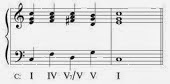
I apologize for the poor quality of the picture, but this is a perfect example of a secondary dominant chord used in the key of C Major. Here we see that the piece starts on the tonic (C), then goes to the subdominant or the Four Chord (F). After the four chord however, something happens that gives us a D Major chord before going to the dominant (G) and resolving with the tonic (C). What is going on? 

This is what is known as a secondary dominant. As defined it is the use of the dominant "of the dominant" of the set key. So if the set key in this case is (C major) the dominant is (G major) and the dominant of that is (D Major). If you have a piano this relationship can be seen my going up two fifth intervals from C. (C --> G --> D). In the key of G major the dominant is D Major (because in G major the F is sharp) and this gives us a chord that is taken outside of its original key but is related to the dominant of the key the piece is played in. 

Secondary dominants can be used in different ways throughout music, and it does not always have to be the dominant of the dominant. You can have a secondary dominant that is based off the (ii) chord in a piece, such as what is used in "Tears of Heaven" by Eric Clapton, or one that is taken from the (Vi) chord as in "Yesterday" by the Beatles. Here is an example of a chord progression that implements secondary dominance:   


In a couple days I will post a follow-up post that has a couple more examples of borrowed chords and secondary dominants, as this was meant to be an introduction to the concept. If you have any comments or questions then please post below, but other than that thank you for reading!

-Sincerely, ZS

Friday, October 18, 2013

Diatonic Chord Progressions: The Baseline of Songwriting

Today we're going to talk about a subject that is very dear to my heart: Chord Progressions and how they relate to songwriting. If you've ever had the dream of becoming a songwriter and given up after little success, there are three things that probably got in your way of becoming famous.

 First of all, as my rhyming dictionary loves to remind me, writing good lyrics takes time and patience to master. Whether you become inspired to write a lyric or it just comes to you in the middle of the night, lyrics need to be refined and practiced in order to be "good". Now "good" is a flexible term because the quality of the lyrics all depends on your audience. Are you writing for the opening of the next concert center in your city, or for personal enjoyment?

This brings us to my second point. Self-confidence is needed in order to be a good writer. The ability to write down a couple lines of lyrics or a measure of melody and be *ok* with what you wrote the next morning is a skill that even I haven't learned yet. The important thing to remember is that no matter what you write down, you need to KEEP IT. Get a journal, take a note on your iPhone, or record it somehow, but don't just throw it away. Keeping ideas around, even if you think it's garbage, will stand as a milemarker to how far you have come as a write, and might even inspire you later on through the words that once didn't.

Finally, and most importantly, beginning song writers don't have a firm concept of chord progressions. To clarify, a chord progression is a series of music chords or notes with the goal of establishing a tonality within a specific key and is based on the succession of root relationships. Big definition right? Let's break this down in todays video, and then apply it to some popular songs so we can understand, as music writers, the fundamentals of chord progressions.

To start with, lets understand that today will only be spent discussing diatonic chord progressions. This means that all the triads and chords we will build our progression from will be within the same key. This means that if we want to make a progression in which the root, or tonic, is in the key of C, we will not find chords that are out of this key (such as Ab or Cm).

Diatonic Chords in the key of C Major

(the 2, 3, and 6 of this progression are minor, meaning that the roman numerals should have lower case (i's))
In the picture above the following chords are shown in the key of C major:

   I                 ii                  iii                   IV                        V                   Vi               Vii diminished
tonic      supertonic      mediant       subdominant         dominant       submediant            subtonic

As stated before, a chord progression is a series of of chords, so we know that in order to create a progression we're going to have to put these chords in some sort of order. But wait, is it really that simple? Well....yes. There are no set rules as to what chords follow others in a chord progression. This leaves room for creativity within compositions so we aren't constrained to a few styles of progressions. That being said, there are guidelines for deciding what chords should follow others in a chord progression.

Typically, root relationships revolved around the distances that chords have from each other. This distance is based from the interval space between the tonic (1st) note of each triad. For example, the root relationship between the (I) and the (iii) chord in the key of C Major is a major 3rd. This is because the root of the (I) chord is (C), and the distance between it and the root of the (iii) chord, (E), is a major third.

These types of relationships form strong connections between chords. In classical music the relationship between the (V) and the (I) chord is important in the context of many cadences. A cadence is a harmonic configuration which gives the phrase of music a sense of resolution or pause. Another relationship in chord progressions that can be heard is the (IV) to (I) cadence, which is often displayed in Church Music as the "A-men" phrase at the end of a prayer.

Lets now apply this to a song that I am currently singing in my Concert Choir.


*Note: This piece is in the key of E Major*

The focus of this picture is the cadence that occurs at the end of the crescendo ("home"). As a baritone, my line goes from an (E) to a (B), which is a 4th interval. But look at the other parts. If we connect the notes that the composer spread throughout the voice parts, then we end up with a (E6) and a (B) Chord. The relationship between these chords is a 4th, but because the piece is in E major this transition is from the tonic chord (I) down to the Dominant (V) if gives the phrase a sense of continuation. Instead of simply ending the phrase and moving on to the next musical idea, this composer decides to create anticipation within the music that brings about the main focus of the piece. 

Let's now look at the opposite within the same piece. 


This is a measure from a later section of the piece in which a cadence is used to end the phrase. Here, the notes I sing in the bass line still have the 4th relationship. The two chords (A6) and (E) also share this relationship. Now if you think about the two cadences we've looked at so far, you'll notice they they both incorporate movement in 4ths. But in the first cadence a 4th is used to introduce a new phrase by going down in tonal movement from the tonic to the dominant, while the second moves down from the subdominant to the tonic. By returning to the tonic chord it brings the phrase to a sense of closure, allowing the music to shift focus or enforce another idea. 

So through these examples we see the affect of movement between the chords. Movement away from the tonic, or any chord really, can have different affects on the music depending on if they're moving up or down the diatonic scale. Through this method, ideas in the music can be expressed as transitions or closing statements, all while using the same relationships between the chords. 

Thanks for reading and if you have any questions about the concept of root relationships and movement let me know by commenting on the post below!

Sincerely, ZS 

Tuesday, September 17, 2013

The Basic Elements of Triads

Today I'm going to start talking about chords, how to identify them, and give some examples of them in musical context.

What is a Chord? A chord is (simply put) any harmonic set of three or more notes. Harmonic. This word means that the notes interact with each other musically through the use of intervals. Now, these intervals can be major, minor, 3rd's, 4th's, etc, almost anything as long as there is more than one interval identified in the chord. Right now, we're going to discuss the simplest form of a chord: A triad.

Triads are the most frequently encountered chords because they are composed of three distinct notes, known as the Root, 3rd, and 5th. The triad gets its name by the root note of the chord. Let's look at an example.


Shown to the left is a C Major Triad. We know it's a triad because there are three notes, and more specifically because these notes are a 3rd apart. In every triad, the interval between consecutive notes will always be a 3rd.


So we know that the interval between (C) and (E) is a M3, and (E) to (G) is a m3. This combination, or a M3 on the bottom of the chord and a m3 on the top of the chord, is what defines a Major Triad.

Since we're going to get to know all four types of triads in this post, I going to list them and describe their qualities (interval wise), and then we'll go over each of them individually. Now don't get overwhelmed with this information, I'll explain each one in more detail when we get to it.

Major Triad: C

(m3)
(M3)

Minor Triad: Cm

(M3)
(m3)

Augmented Triad: C aug

(M3)
(M3)

Diminished Triad: C dim

(m3)
(m3)

Minor Triads


To the left is an example of a Cm triad. Notice that the relationship between the notes is are thirds, and the bottom interval is a Minor 3rd, while the top is a Major 3rd. The chords are going to sound "minor", or sad you'll notice in popular music. 


Augmented Triads


To the right is an example of a C augmented Triad. An augmented triad is characterized by having a Major 3rd on the bottom, and another Major 3rd on the top half of the chord. Notice that the relationship of the 5th with the root of the chord also changes as the 5th is raised up a semitone, creating an augmented 5th (Hence where the interval gets its name)


Diminished Triads

To the left is an example of a C diminished triad. Diminished triads are characterized by two minor 3rd's on top of each other. Again, because the 5th has now been lowered to create the m3rd need, the 5th interval has become diminished. 


So let's work through a couple more examples to really understand how to construct triads;

------------------------------------------------------------------------------------

What is the triad above?

(D augmented)

Why?

(Because the relationship between (D) to (F#) is a Major third, and the relationship between (F#) and (A#) is also a Major third)


------------------------------------------------------------------------------------

What is the triad above?
(Remember the Root of the chord gives its' name)

(B diminished)

Why?

((B) to (D) is a m3rd, and (D) to (F) is a m3rd)


------------------------------------------------------------------------------------

What is the triad above?

(Gm)

Why?

((G) to (Bb) is a m3rd, and (Bb) to (D) is a M3rd)


------------------------------------------------------------------------------------
So, to recap: Triads are three note chords composed off thirds. Depending on the quality of these chords, the triad can be major. minor, augmented, or diminished. And remember, the name of the triad (Note wise) is always given by the root of the chord (The bottom note for now). 

In a couple days I will post an example of some triads in my choral music, and then next week we will talk about triads in inversion, an then move on to more complicated chords. 

Thanks for reading, and if you have any more questions, feel free to comment below. 

Sincerely, ZS